
By Olu • May 2026
The Stone Age didn’t end because we ran out of stones. It ended because we found better materials.
That single idea explains almost everything happening in the economy right now. But most of the conversation around AI is abstract, technical, and frankly hard to follow if you’re not in the industry.
This article is for you, the person who keeps hearing the noise and isn’t sure what to make of it. The person who tried an AI tool once wasn’t impressed and moved on. The person arguing for or against something they can’t quite visualize yet.
I’m not here to be technical. I’m here to make it concrete. Because I trust that brilliant-minded people and creatives, when they truly understand what’s shifting, will have sharper critiques and better arguments; and that’s what actually shapes where the economy goes.
So here’s an analogy. Let’s go back to the Stone Age.
The Beginning: The Stone Age of Work
Imagine we’re in the Stone Age: caves, fire, and stones.
Survival depends on what you can make with your hands. You break a stone, get a sharp edge, and use it to cut meat, skin animals, or craft weapons. The economy runs on manual skill and survival tools.
Everyone uses their stone for what matters most. Hunters sharpen theirs for the kill. Warriors shape theirs into spears. Builders carve theirs to split wood for shelter. These are the respected trades, the serious work that keeps the tribe alive.
Now, imagine one villager decides to do something different.
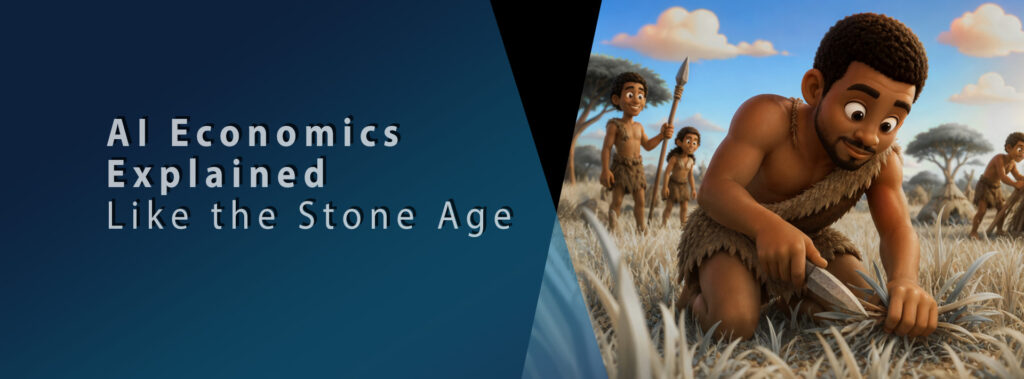
While everyone else is hunting, fighting, and building, this villager uses his stone to cut grass.
Not to survive. Not to feed anyone. Not to defend the village. He just likes the way it looks when the grass is even. He likes the patterns. He likes the way a cleared field feels when you walk across it.
People laugh. “We’re out here keeping the tribe alive, and this one is trimming weeds.”
But he keeps going. Twenty years later, he’s a grass-cutting master. Every blade, every angle, every technique. While others measure their skill in kills and conquests, he measures his in something nobody else values.
Yet.
That’s the world before AI. Some crafts are seen as essential. Others are seen as decorative. But mastery is mastery, regardless of whether the tribe respects it today.
Then Everything Changes
One day, humanity discovers new materials: metal, glass, plastic, and rubber, all at once.
The world explodes with possibility. Metal can be shaped with fire, lasts longer, and cuts cleaner. Plastic and rubber make tools lighter, faster, and scalable. The combinations are endless.
This is the AI moment. Not one invention, but a sudden flood of new materials for creation.
The world isn’t about sharp stones anymore. It’s about what you build with these new materials.
The First Experience Is Usually a Bad One
And this is where it gets important, because it explains why so many smart people are skeptical.
Someone wraps plastic around your stone handle. An upgrade, supposedly. You didn’t ask for it. But the wrap is an afterthought, someone’s five-minute fix for a problem they didn’t bother to understand. First swing feels fine. Second swing, the stone wobbles. Third swing, it flies out of your hand.
Now you’re worse off than before. You had a rhythm with the bare stone, and this “improvement” just broke it.
“This new material is garbage. My stone was fine.”
Sound familiar?
Then someone hands you a glass blade. Beautiful. Sharper than anything you’ve seen. Catches the light like it was made for display. You take one swing, and it shatters.
“See? All hype.”
But here’s what actually happened. The plastic wrap was lazy engineering, a new material slapped onto an old tool by someone who never studied how things really workyou work. The glass blade was the wrong material for the wrong job — a showpiece handed to someone who needed a workhorse.
Neither failure was about the materials. Both were about the application.
This is exactly where most people are with AI right now. They tried something half-baked, poorly matched to their actual work, and it failed. So they concluded the whole thing was overblown.
The difference between that cheap plastic wrap and a properly engineered machete is enormous. Same new materials. Worlds apart in execution.
The machete is coming. Most people just tried the plastic wrap first and gave up before the real tools arrived.
The Old Masters Resist
Meanwhile, the grass-cutting master has spent twenty years perfecting his craft. Then he sees a newcomer pick up a machete; a metal blade with a rubber grip, engineered for cutting; and start working.
Their technique is sloppy. They don’t read the grass the way he does. They don’t understand the craft.
But they’re cutting twice as fast, cleaner, and they started last week.
So he starts defending his stone. He tells stories about “real craftsmanship.” He finds others who agree, and they form a community of stone purists. They reassure each other that the old way is the right way.
Meanwhile, the people they’re mocking aren’t even cutting grass anymore. They’re mining iron, refining metal, and building the factories that produce machetes by the thousands.
That’s how industries change. Masters of the old tools defend their pride while builders of the new tools quietly take over.
Every. Single. Time.
But it doesn’t have to end there.
Because there’s always one master who sees it differently. While the others are clutching their stones, this one puts his down and picks up the machete.
And something remarkable happens.
The newcomer with a machete is fast, but reckless. They hack at the grass. They don’t know which angle works when the ground is wet. They don’t understand which grass you cut low and which you leave tall. They have speed but no instinct.
The master with a machete is something else entirely. Twenty years of reading terrain, understanding seasons, knowing exactly where to cut and how deep — all of that knowledge doesn’t disappear when the tool changes. It multiplies. The machete in his hands isn’t just faster. It’s precision at speed. It’s wisdom with leverage.
He doesn’t just keep up with the newcomers. He leaves them behind. Because the newcomer has a tool. The master who adapts has a tool and the judgment to use it in ways the newcomer can’t even see yet.
That’s the part most people miss in the AI conversation. The fear is that new tools make expertise irrelevant. The reality is the opposite. Expertise becomes MORE valuable with better tools, not less. A new graduate with ChatGPT is useful. A twenty-year veteran with ChatGPT is dangerous.
The tragedy was never that newcomers picked up machetes. The tragedy is every master who refused to.
By defending the stone, they weren’t protecting their craft. They were handing their advantage to people with less skill. The very thing they feared, being outperformed by amateurs, they caused by standing still.
What If You Choose to Keep Your Stone?
Here’s the part nobody likes to hear.
If you choose to stay with your stone, you won’t disappear. Not immediately.
Stones still work. Your skill is real. Your craftsmanship is genuine. And for a while, there will be people who appreciate that — people who value the handmade, the original, the authentic.
But the people with machetes take your everyday customers. The people with machines take your large contracts. Your market shrinks. You’re not competing for the mainstream anymore; you’re serving a niche.
And the niche gets smaller.
Stones don’t vanish overnight. They fade, like sand. Grain by grain, so slowly you barely notice until one day you look around and the world has moved on.
Then it gets worse.
Eventually, someone creates faux stones. They look like real stone. They feel like real stone. To most people, they’re indistinguishable. But they’re manufactured, cheaper, and everywhere.
Now even your authenticity; the one thing you thought couldn’t be replicated has competition.
This isn’t a prediction. It’s a pattern. Vinyl records became a niche when digital arrived. Hand-drawn animation became a specialty when CGI took over. Film photography became a craft movement while the world went digital.
The original never fully dies. But it stops being the economy. It becomes a memory. A luxury. A collector’s item.
The question isn’t whether your stone still works. It does. The question is whether you want to serve an audience that shrinks every year or learn the new materials while the window is still open.
The Economic Shift
This isn’t just about rocks. It’s about resources, leverage, and control.
As the world moves from stones to engineered tools, people naturally sort into levels.
The villager doesn’t think about materials at all. Their tools just quietly get better one day — a properly molded grip, a sharper edge, a lighter handle. Life improves, and they don’t question why. Most people are here. You don’t need to understand how electricity works to turn on a light. And that’s perfectly fine, as long as you know the light exists.
The craftsman makes a conscious choice. They trade their stone for a machete. Same task, purpose-built tool, dramatically better results. They didn’t build the machete, but they chose it wisely, and they’re learning its strengths.
The toolmaker stops cutting entirely. They realize the value isn’t in cutting grass, it’s in building machetes that thousands of cutters will buy. One good design, replicated and sold, is worth more than a lifetime of personal cutting.
The system builder goes deeper still. They design the factories that produce machetes at scale, then move beyond blades entirely, building machines that cut, harvest, and reshape the landscape without a human swinging anything. They don’t touch grass. They shape the entire economy around it.
And here’s what makes the system builder different: they usually started as a craftsman. They know every blade of grass, every angle, every technique, and that knowledge becomes the blueprint. Because you can’t build a great machine if you’ve never done the work by hand. You won’t know what matters. You won’t know where the old tools fail. You won’t know what the craftsman actually needs.
Each level compounds leverage. The further up you go, the more scalable your impact.
The Real Question
AI, like metal or fire, isn’t one single invention. It’s a material.
The power lies in how you use it.
You can benefit without knowing, like the villager whose tools quietly improve around them.
You can choose better tools, trade your stone for a machete, and do your work faster and cleaner.
You can build tools for others, stop cutting, and start making machetes.
Or you can create systems that change the landscape entirely.
Most people will never touch the raw materials directly. That’s fine. But understanding that the materials exist, that the tools are being built, and that the landscape is shifting – that’s the minimum. That’s knowing the light switch exists even if you never open the electrical panel.
The question isn’t if AI will change your work.
At what level will you choose to play?
The Lesson
The Stone Age didn’t end because we ran out of stones. It ended because we found better materials.
AI is the next material. Not to replace human work, but to expand what’s possible when we combine creativity, craft, and computation.
If you choose to keep your stone, that’s your right. Your craft is real. Your skill is earned. But stones fade into sand so slowly you might not notice until it’s too late.
So whether you’re the villager enjoying better tools, the craftsman swinging a machete, the toolmaker building for thousands, or the system builder designing the factory…
Start somewhere.
The future belongs to those who see the material, not just the tool.
A quick note: AI as a material is already complex enough. What makes it even more extraordinary is that this material learns: it adapts, improves, and reshapes itself the more you use it. That layer of intelligence compounds everything I’ve described in this article. But that’s a conversation for another day. For now, understanding AI as a material is the foundation. The intelligence layer is what you build on top of it once this clicks.