
This was written in late 2025 when Page2Play was focused on education and ministry. Since then, we've pivoted toward enterprise B2B — read the agentic AI series for where the product is heading.
I’ve had the same conversation a dozen times now.
A church, school, or publisher sees Page2Play: our AI platform that turns written stories into animated videos. They watch the demo. Their eyes light up.
“This is exactly what we need.”
Then comes the pause. The look between colleagues. The question I’ve learned to dread:
“This seems pretty straightforward. Could we just build something like this ourselves?”
Six to nine months later, some of them come back. They’ve spent $50,000 or more. They’ve burned through developer hours and AI tokens. And they still can’t get their results and output to look consistent and production-ready.
They learned the hard way: just because something works simply doesn’t mean it was simple to build.
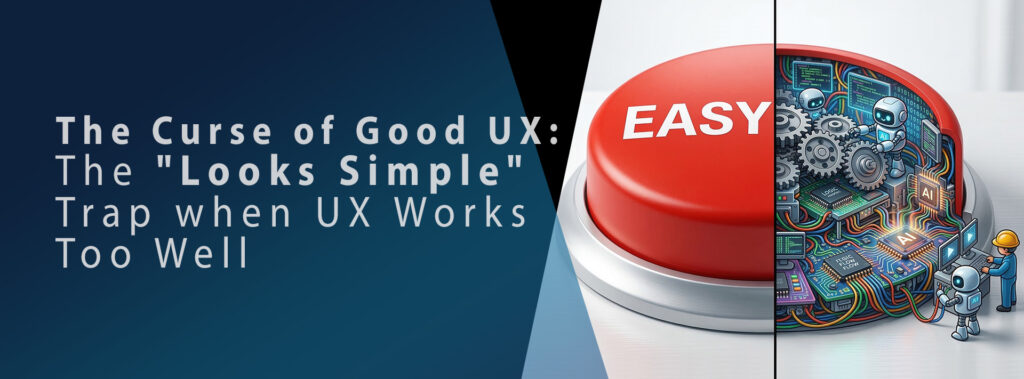
The Curse of Good Design
Here’s the irony: the better your product works, the easier it looks to replicate.
When someone uses Page2Play, they see:
- Paste a story
- Pick characters
- Click Start
- Get a video in 5-10 minutes
What they don’t see:
- 18 months of R&D on the engineering workflow evolution and model
- Thousands of failed experiments and working with teams before we solved it
- Nine different AI systems working together seamlessly
- Automatic quality checks and retry logic
- Edge cases that took months to handle
Good UX hides complexity. That’s the point. But it also creates an illusion.
The smoother the experience, the more people think: “How hard can it be?”
The Build vs. Buy Illusion
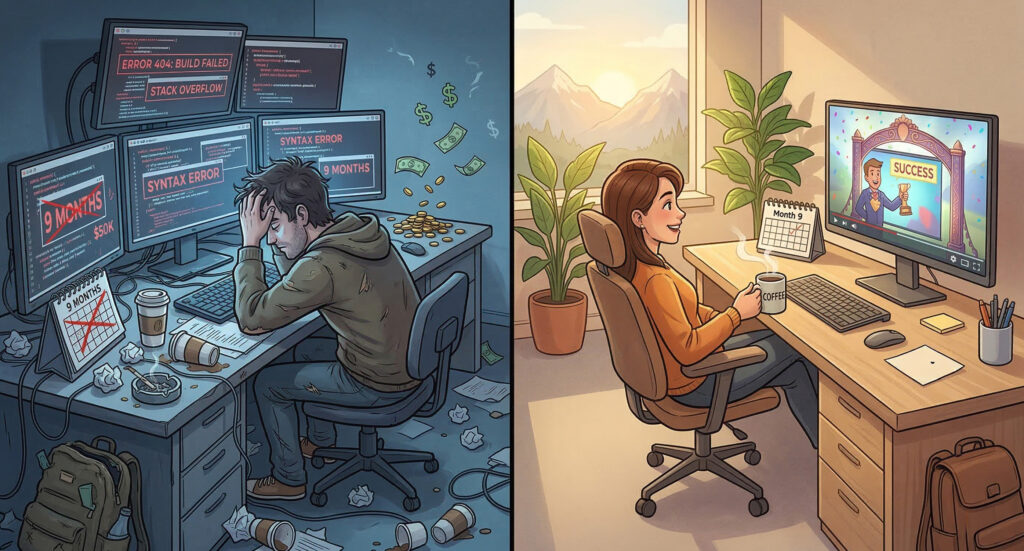
When organizations decide to build instead of buy, they’re usually making a few assumptions:
Assumption 1: “We have developers. They can figure it out.”
Reality: Your developers are great at what they do. But video production isn’t their expertise. They’ll spend months learning what we’ve already solved.
Assumption 2: “We’ll own the technology.”
Reality: You’ll own a half-finished system that requires constant maintenance, updates, and fixes-pulling your team away from your actual mission.
Assumption 3: “It can’t be that complicated.”
Reality: Character consistency alone-keeping the same character looking the same across multiple frames-is a problem that billion-dollar companies haven’t fully solved. We did. It took six months of focused work.
Assumption 4: “We’ll save money in the long run.”
Reality: Let’s do the math.
| Build Internally | Buy Page2Play |
| 10-18 months of development | Start this week |
| $50,000-$100,000+ in dev time | $2,400/year |
| Ongoing maintenance forever | We handle updates |
| Uncertain outcome | Proven, working product |
The “savings” evaporate quickly.
What’s Really Under the Hood
Let me pull back the curtain on what makes “paste story, get video” actually work:
1. Story Intelligence:
The system reads your entire narrative. It identifies characters, locations, emotional beats, and scene transitions. It understands pacing. This isn’t keyword matching-it’s comprehension.
2. Character Consistency (The Hard Part):
Every AI image generator has the same problem: generate a character twice, get two different-looking people. Hair color changes. Face shape shifts. Clothing transforms.
We solved this with what we call “lineup locking”-a proprietary system that maintains character identity across every single frame. This is our core IP. It took months to build and refine.
3. Quality Control:
Not every AI-generated frame is good. Our system automatically evaluates each frame, checks for consistency, and retries when something doesn’t match. You never see the failures-only the successes.
4. Voice and Lip-Sync Integration:
We don’t just generate video. We integrate professional voice synthesis with automatic lip-sync, so characters actually speak their dialogue naturally. Try building that from scratch.
5. Continuous Improvement
Every week, we ship improvements. Better prompts. Faster generation. New features. If you build internally, you’re building yesterday’s product. We’re building tomorrow’s.
The Question I Now Ask Early
I’m learning to address this head-on. Before any deep demo, I ask:
“Have you considered building something like this internally?”
If they say yes, I don’t get defensive. I get curious.
“Tell me more. What’s your timeline? What’s your budget? Do you have AI/ML expertise on staff?”
Then I share the reality:
“I’ve watched organizations go down that path. Most spend 6-9 months and $50K+ before they realize the complexity. Character consistency alone is a problem most teams never solve. I’m happy to show you exactly what makes this hard, so you can make an informed decision.”
Transparency builds trust. And it reframes the conversation.
The Real Question
When an organization considers building vs. buying, the real question isn’t “Can we build this?”
The real questions are:
1. Is this our core competency? If you’re a church, your mission is ministry-not AI development. If you’re a publisher, your mission is stories-not video infrastructure. Every month spent building tools is a month not spent on mission.
2. What’s our time worth? You could start creating videos this week. Or you could start creating videos in 9 months-maybe. What happens to your programs, your content, your audience in that gap?
3. What’s the true total cost? Development is just the beginning. There’s maintenance, updates, bug fixes, scaling, and security. That “free” internal tool has ongoing costs forever.
4. What’s the cost of failure? If your internal build doesn’t work-and statistically, most don’t-what have you lost? Time, money, momentum, and maybe the window of opportunity.
When Building Makes Sense
I’m not saying “always buy.” There are times when building internally is the right call:
- It’s your core business. If AI video generation IS your product, build it.
- You have unique requirements that no existing product can meet.
- You have deep AI/ML expertise already on staff.
- You have 12-18 months and a significant budget to invest.
- You’re okay with ongoing maintenance indefinitely.
If that’s you, build away. Seriously.
But if you’re a church that wants to engage kids with animated Bible stories? A school that wants teachers to create video lessons? A publisher that wants books transformed into video content?
Your mission isn’t building AI tools. Your mission is impact.
Buy the tool. Focus on the mission.
The Comeback Conversations
Some of my favorite people are the ones who tried to build it themselves first.
They come back humbled. They’ve seen the complexity firsthand. They no longer think “how hard can it be?” They know exactly how hard it is.
And they’re ready to move fast, because they’ve already lost 6-9 months.
I don’t say “I told you so.” I say, “Let’s get you creating videos this week.”
But I’d rather you skip the painful detour altogether.
The Bottom Line
If you’re evaluating a tool and thinking “we could build this ourselves”-pause.
Ask yourself:
- Do I truly understand what’s under the hood?
- Is this our core competency?
- What’s the real total cost (time, money, opportunity)?
- What happens to our mission while we’re building infrastructure?
Simple-looking products are often the hardest to build. That’s not a bug-it’s a feature.
The best tools disappear into the workflow. They feel effortless. They make hard things look easy.
That’s the whole point.
Don’t mistake ease of use for ease of creation.
Olu Abiba is the founder of Page2Play, an AI platform that transforms written stories into videos. He’s watched enough organizations try to build it themselves to know how the story usually ends.